
Regulatory change in England is rarely a singular, explosive event. Instead, it is a persistent, quiet erosion. When the Care Quality Commission (CQC) updates a Quality Statement or when NHS England releases new guidance on integrated care, the impact on a service is immediate. Yet, the mechanism for absorbing those changes is often tragically slow. Most providers rely on static documents, email updates, or occasional team meetings to disseminate information, assuming that because a policy was sent, it was understood and is being applied. This assumption is the greatest single risk to your regulatory standing.
Under the Single Assessment Framework (SAF), the regulator is not looking for a library of well-written policies; they are looking for evidence that those policies are living, breathing, and understood by the people on the front line. When an inspector asks how you ensure your team is working to current legislation, a signed acknowledgement form from three months ago is rarely enough. The real challenge is maintaining policy currency—ensuring that every shift in national guidance is reflected in your practice, and more importantly, that your staff have that knowledge at their fingertips the moment they need it.
This is where the divide between managerial intent and frontline reality becomes most apparent. Most compliance tools on the market are built for the manager and merely tolerated by staff. They treat the frontline as a data-entry burden, requiring them to engage with dashboards, compliance scores, and governance terminology that is entirely disconnected from their daily reality of providing care. The result is shallow, performant compliance—staff tick the boxes, but the underlying knowledge remains unchanged. We believe this model is broken. At policynow.uk, we designed a system based on the principle of mutual benefit: two experiences, one platform.
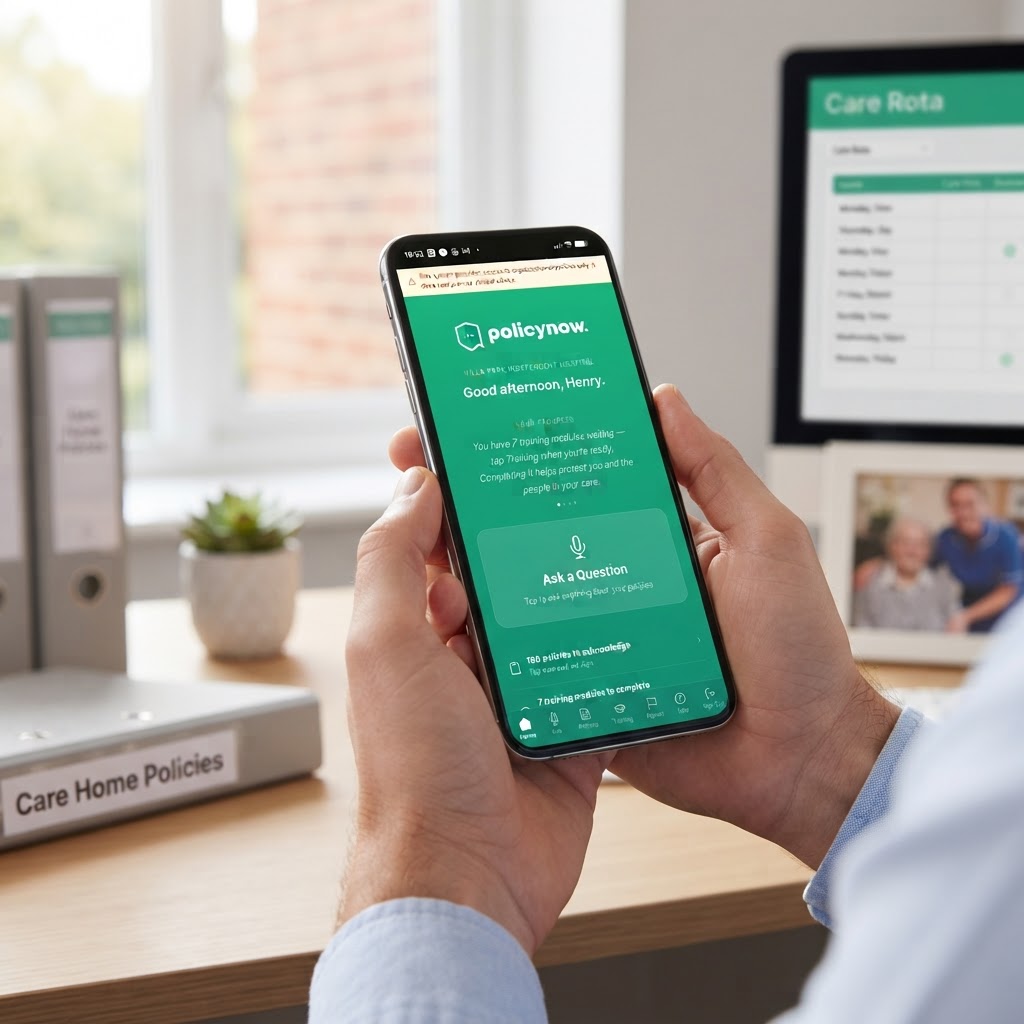
For the frontline, the interface is stripped of all managerial machinery. It is dominated by our Ask PolicyNow feature, which allows staff to ask questions in plain English—by voice or text—and receive an instant, accurate answer derived solely from your organisation’s own uploaded policies. If a support worker is unsure about a complex medication administration procedure at 11pm, they don’t have to hunt through a dusty manual or guess. They ask, they get the answer with a direct link to the relevant section, and they can continue providing care with confidence. It minimises friction; it provides the help they need at the moment of pressure.
Crucially, this interaction is logged in the background, not to surveil the worker, but to provide the manager with the objective evidence that the policy is being consulted and understood. While the staff member gets the answer they need, the manager gains continuous, trustworthy evidence of compliance. There is no surveillance here; there is only evidence generation that happens as a byproduct of helping your staff do their job. When an inspector arrives, you are already prepared—you don’t need to explain your compliance culture; you demonstrate it through a comprehensive, timestamped audit trail that shows exactly which policies are being utilised and where the gaps might lie.
This system addresses the reality that staff are busy, experienced professionals who do not have the time to wade through corporate documentation. By giving them a tool that simplifies their day, you gain the granular oversight needed to manage risk effectively. Managers get the full power of our dashboard: Inspection Readiness Scores with specific Score Drivers, automated training module generation, and nightly monitoring of regulatory sources across all four UK nations. We ensure that when a change occurs, you are alerted and given the option to amend your policy, which is then updated and pushed out to staff, ensuring the loop of compliance is closed. You are always ready before you are asked, because the evidence is being built throughout the day, not in the panic-filled hours before an inspection.
Compliance should not be a task that sits on top of your day; it should be integrated into the rhythms of your service. By moving away from static paper-based processes and adopting a platform that respects the different needs of leaders and staff, you shift from explaining your standards to demonstrating them. Whether you are managing a care home or a complex multi-site group, the goal remains the same: ensuring your team is empowered to do the right thing, every time, supported by a system that makes the complex simple.
Find out how Policy Now can help your organisation →
References & Further Reading
- https://www.gov.uk/government/publications/uk-trade-strategy/the-uks-trade-strategy
- https://www.gov.uk/government/publications/a-new-approach-to-ensure-regulators-and-regulation-support-growth/new-approach-to-ensure-regulators-and-regulation-support-growth-html
- https://www.cityoflondon.gov.uk/assets/Business/UK-crossborder-trade-in-services-with-Australia.pdf
- https://assets.publishing.service.gov.uk/media/687e612692957f2ec567c621/Financial_Services__Growth___Competitiveness_Strategy_final.pdf
- https://assets.publishing.service.gov.uk/media/5a7cc85ae5274a2f304f00bd/12-1083-wr1-chief-economist-workshop-macro-drivers-of-change.pdf
- https://www.gov.uk/government/publications/regulation-for-the-fourth-industrial-revolution/regulation-for-the-fourth-industrial-revolution
- https://assets.publishing.service.gov.uk/media/642561b02fa8480013ec0f97/6.8300_HO_Economic_Crime_Plan_2_v6_Web.pdf