Medicines management is often the most fragile component of a care home’s regulatory standing. It is a domain where the margin for error is non-existent, yet the process is frequently shackled to systems that were designed for an era of paper sign-off sheets and static filing cabinets. When the Care Quality Commission (CQC) conducts an inspection under the Single Assessment Framework, they aren’t looking for a pristine policy document hidden in a manager’s office. They are looking for evidence that those policies are lived, understood, and applied by the person administering medication at 2am.
The disconnect between high-level policy and frontline delivery is a common failure point. Managers spend hours drafting robust, compliant procedures that align with NICE guidelines on managing medicines in care homes, only to watch those documents disappear into an archive. When a staff member is faced with a query about a medication administration record (MAR) or a subtle change in a resident’s condition, they rarely have the time or the inclination to hunt through a three-ring binder. They reach for the most accessible information, which is often ‘how we’ve always done it,’ even when that deviates from the latest best practice.
This is where the traditional compliance model collapses. We expect frontline staff to maintain rigorous standards while providing them with the least efficient tools to achieve them. It is an operational burden that creates unnecessary friction, leading to gaps in knowledge that inevitably appear as ‘Requires Improvement’ in inspection reports. As noted in the Skills for Care workforce development guidance, effective support for staff is about removing barriers to competence, not just mandating more training.
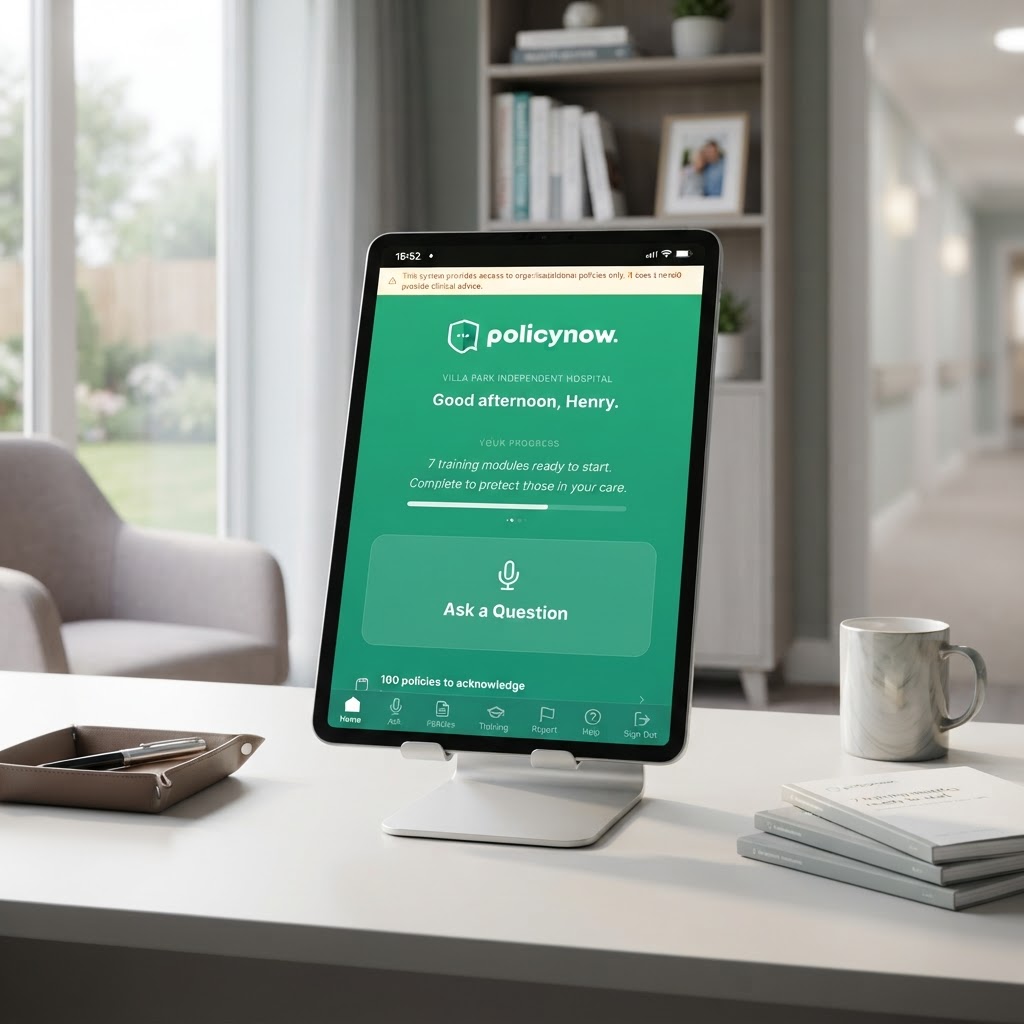
We need to stop treating compliance as an administrative exercise and start treating it as an information-access problem. PolicyNow was built on the principle that compliance should be simple for staff and powerful for leaders. The core of this approach is a deliberate bifurcation of the user experience. By providing frontline staff with a clean, mobile-first interface designed for their specific reality, we remove the friction that leads to policy non-compliance.
Instead of navigating cumbersome menus, a carer can use the voice-first ‘Ask’ feature. At the end of a long shift, they can speak a question into their device and receive an answer drawn solely from the organisation’s own, approved policies. There is no guesswork, no reliance on outdated memory, and no clinical advice provided by AI—only the organisation’s own rules, cited and clarified instantly. By bringing what they need to the front, we ensure that the right way is the easiest way.
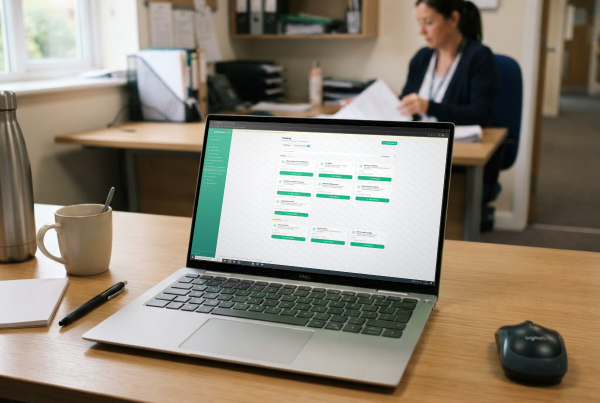
For the Registered Manager, this translates into ‘continuous, trustworthy evidence.’ While staff see a simplified, non-intimidating interface, leaders gain access to a full compliance dashboard. This provides a clear, real-time view of what has been read, what has been understood through comprehension checks, and where the gaps lie. It allows you to demonstrate, not explain, your compliance culture. When an inspector walks through the door, you don’t need to scramble for paper trails or chase signatures; you have a timestamped, digital audit log that shows exactly how your team has been engaged with your policies.
This dual-track system—simple for staff, powerful for leaders—means you are ready before you are asked. You aren’t just ticking a box; you are building an evidence-based culture where governance happens as part of the daily rhythm of the home. Complexity is handled by the platform, ensuring the frontline experience remains uncluttered and focused on care.
When we align our technology with the practical realities of the care sector, we stop fighting against the daily friction of compliance and start managing it. We move away from the myth that more documentation equals better safety, and toward a reality where staff are empowered with the right information at the exact moment they need it. This isn’t just about passing the next inspection; it is about building an organisation that is fundamentally more resilient and a care environment that is consistently safer.
—
Find out how Policy Now can help your organisation →
References & Further Reading
- https://www.cqc.org.uk/guidance-providers/adult-social-care/medicines-information-adult-social-care-services
- https://www.cqc.org.uk/guidance-providers/adult-social-care/medicines-administration-records-adult-social-care
- https://www.nice.org.uk/guidance/qs85/resources/medicines-management-in-care-homes-pdf-2098910254021
- https://www.cqc.org.uk/guidance-providers/adult-social-care/training-competence-medicines-optimisation-adult-social-care
- https://www.nice.org.uk/guidance/sc1/chapter/1-recommendations
- https://www.cqc.org.uk/guidance-regulation/adult-social-care/learning-safety-incidents/issue-9-medicines-management
- https://www.skillsforcare.org.uk/resources/documents/Support-for-leaders-and-managers/Managing-a-service/Prevention-in-social-care/Medicines-management-resources/B-Medicines-checklist-guidance-and-resources.pdf