
Ask a care home nurse where the infection control policy is, and you’ll usually get an answer that involves a folder, a drawer, or a member of staff who isn’t on shift today. Ask them what it actually says about managing a suspected outbreak at 2am, and the folder becomes even less useful.
This is the quiet, persistent problem behind most CQC findings under the Safe and Well-Led key questions. It’s not that care homes lack policies. It’s that the people expected to follow them can’t reliably lay hands on the right document at the moment it matters — and the home can’t reliably prove they’ve read it.
The conventional answer is the staff handbook, the email circular, and the sign-off sheet taped to the office wall. None of these survive contact with a busy rota. Sheets go missing. Emails bury themselves under agency timesheet requests. The folder in the manager’s office helps no one on a night shift in the upstairs landing. Under the Single Assessment Framework, inspectors assessing the “Supporting people to stay safe” and “Governance, management and sustainability” quality statements are looking for evidence that policy isn’t just written, but lived — that staff know what to do, and that leaders know they know. CQC guidance on the Safe key question is clear that knowledge and application, not just documentation, is what counts.
This is the gap that QR Code Policy Access in PolicyNow was built to close.
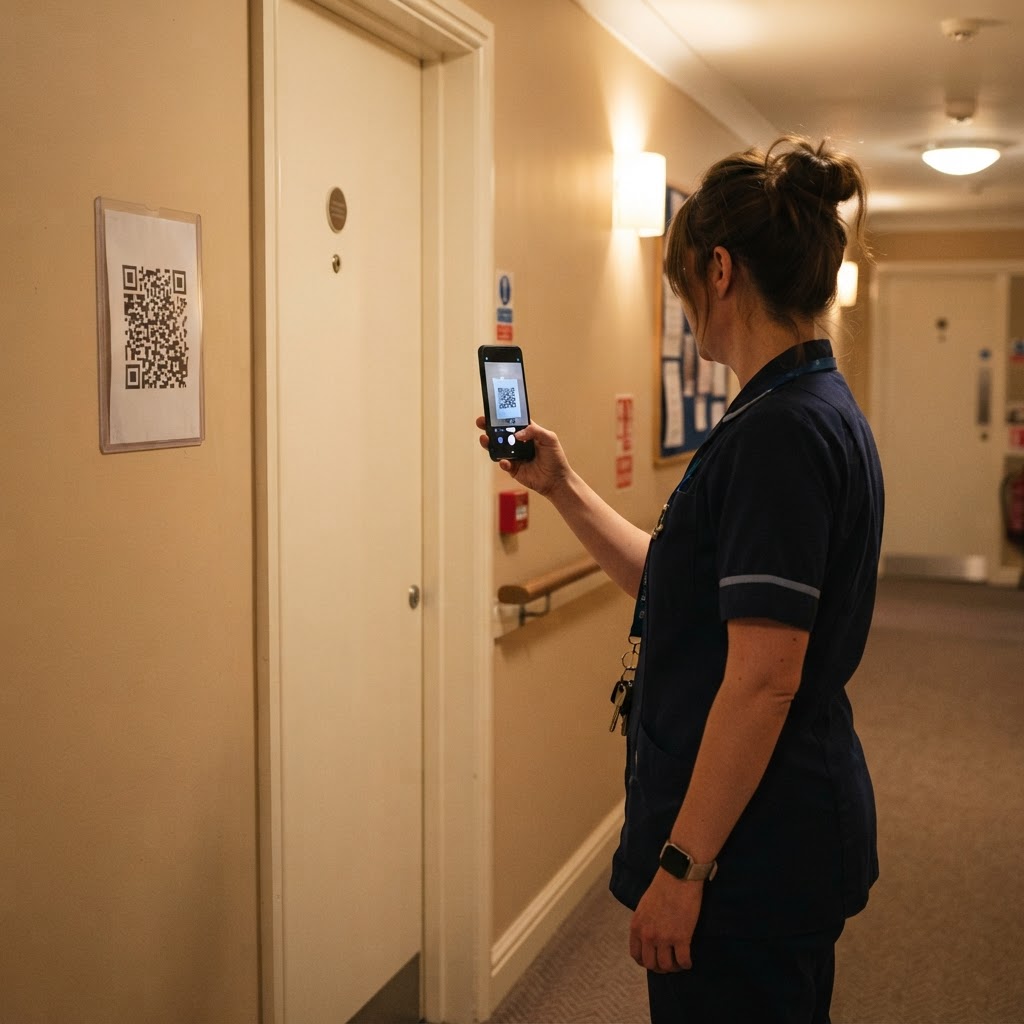
The mechanism is deliberately simple. For any room, noticeboard, or workstation in the home, a manager prints a QR code linked to a specific policy — infection prevention and control by the clinical room door, falls response in the lounge, medication administration by the treatment trolley, safeguarding by the staff room board. A member of staff scans it with their phone, confirms their identity with a personal PIN, and lands directly on that policy. Not a portal. Not a search. The exact document, at the exact moment they need it.
What makes this different from sticking a laminated printout on the wall is what happens after the scan. Every access is logged. The system records who opened the policy, which version, and when. If a staff member reads the falls policy three times in a week because they’ve had two incidents, that’s visible. If no one has opened the medication policy in six months, that’s visible too. The audit trail builds itself through ordinary behaviour, not through a separate bureaucratic ritual.
This matters because the traditional sign-off sheet is, for inspection purposes, nearly worthless. It tells you someone signed a piece of paper on a Tuesday. It tells you nothing about whether they understood what they signed, whether they read the right version, or whether they’d recognise the procedure in a real situation. Under Regulation 18 of the Health and Social Care Act 2008 (Regulated Activities) Regulations 2014, providers must ensure staff are properly supported, trained, supervised, and appraised — and that support includes having access to the information they need to do their job safely. Skills for Care workforce data consistently shows that turnover and reliance on bank and agency staff remain significant challenges in adult social care, which makes the assumption that everyone “just knows” the home’s procedures increasingly fragile.
QR access also solves a second, less obvious problem: version drift. When policies are updated, the printed copies on the wall don’t. The folder on the shelf doesn’t. The photocopy in someone’s locker certainly doesn’t. A staff member who learned the old falls procedure two years ago and has never been prompted to re-read it may be acting on information the home has since revised. With PolicyNow, when a policy changes meaningfully, staff who previously acknowledged it are automatically prompted to re-read and confirm — and when they do, they see exactly what moved, section by section, before and after. The QR code on the wall always points to the current, approved version. There is no paper copy to forget about.
For Registered Managers, the cumulative effect is that the question “How do you know your staff follow your policies?” stops being a moment of anxiety. The answer isn’t a hopeful statement about training days or a binder of sign-off sheets. It’s a timestamped, per-policy audit log showing who has read what, when, and which version. That’s the kind of evidence that holds up under scrutiny — not because it’s impressive, but because it’s true.
There’s also something to be said for the cultural signal this sends. A home that puts QR codes on its walls is telling staff that policies aren’t something you read once during induction and forget. They’re living documents, relevant to the room you’re standing in, available when you need them. That’s a different relationship with compliance than the one most frontline staff have experienced. It treats them as professionals who need the right information at the right time, not as people to be chased for signatures.
None of this replaces clinical judgement or good management. A QR code doesn’t make someone a better carer. But it removes the friction between a good policy and the moment it needs to be applied — and it leaves a trail that proves the effort was made. In a sector where the difference between a Good and a Requires Improvement rating can hinge on whether an inspector believes your staff actually know your procedures, that trail is not a minor convenience. It’s the substance of governance.
Stephen Potts and the team at Policy Now Ltd built this feature because the old methods — the folders, the sheets, the emails — were never really working for anyone. They were working for the file. PolicyNow works for the shift.
See the full capability, including PIN-secured access, automatic re-acknowledgement on policy change, and the per-policy audit trail, at https://policynow.uk. Book a demo and watch a QR code take an inspector from a blank wall to a complete evidence trail in under five seconds.
Find out how Policy Now can help your organisation →
References & Further Reading
- https://www.gov.uk/government/publications/care-act-statutory-guidance/care-and-support-statutory-guidance
- https://www.england.nhs.uk/wp-content/uploads/2016/09/ehch-framework-v2.pdf
- https://www.gov.uk/government/publications/adult-social-care-coronavirus-covid-19-winter-plan-2020-to-2021/adult-social-care-our-covid-19-winter-plan-2020-to-2021
- https://www.kingsfund.org.uk/insight-and-analysis/long-reads/shared-responsibility-health
- https://www.skillsforcare.org.uk/Developing-your-workforce/Guide-to-developing-your-staff/Statutory-and-mandatory-training.aspx
- https://www.skillsforcare.org.uk/resources/documents/Developing-your-workforce/Care-topics/Delegated-healthcare-interventions/Research-into-social-care-workers-undertaking-healthcare-interventions.pdf
- https://www.england.nhs.uk/wp-content/uploads/2013/11/nqb-how-to-guid.pdf