Every Registered Manager knows the frustration of the ‘document graveyard’. You spend weeks drafting, reviewing, and approving the perfect policy on safeguarding or medication management. You host the meetings, you print the sign-off sheets, and you file the folders away in a dusty cabinet or a forgotten sub-folder of a shared drive.
Yet, when an inspector asks a frontline staff member a fundamental question about those procedures, the answer is often a blank stare or a vague recollection of a paper signed months ago. This isn’t a failure of staff intelligence; it is a failure of operational design.
As noted in the Care Quality Commission’s (CQC) ongoing focus on leadership and governance, the gap between policy as written and policy as lived remains a critical risk to service quality. Across all four UK nations, regulators — from the Care Inspectorate in Scotland to the RQIA in Northern Ireland — are increasingly scrutinising how organisations turn static documents into consistent, daily practice.
The Problem with the Traditional Approach
The traditional reliance on email chains and paper trails for policy acknowledgement does nothing to ensure comprehension or provide support when it is actually needed. It creates a ‘compliance as a burden’ culture, where the staff member views the policy as a hurdle to jump over rather than a tool to help them provide safer care.
If a policy is not accessible at the point of care, it effectively does not exist.
The solution is not to push more information at staff, but to rethink the delivery mechanism entirely. Modern compliance requires a departure from the ‘one-size-fits-all’ document store, moving instead toward an interface that respects the reality of the frontline.
Two Experiences, One Platform
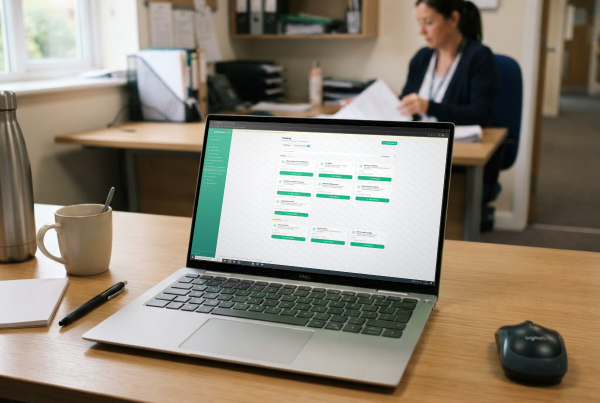
This is where the distinction between the management perspective and the frontline experience becomes vital. At policynow.uk, we have developed a platform built on the principle of “Simple for staff. Powerful for leaders.” This means creating two distinct experiences that serve the same purpose: giving the leader trustworthy evidence while giving the staff member immediate, friction-free clarity.
The Frontline Experience
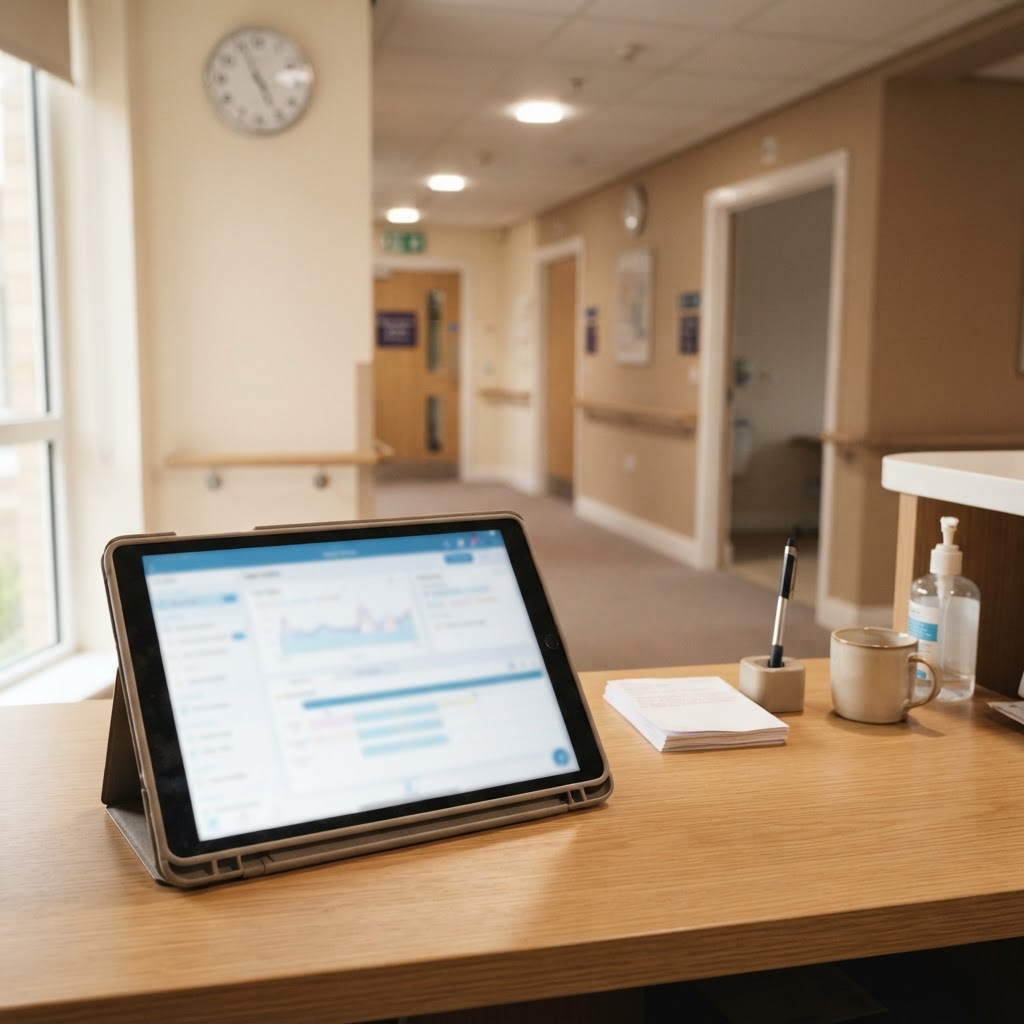
For the frontline worker, this means a clean, mobile-first dashboard that cuts through the noise. There are no complex folders or confusing hierarchical menus. Instead, the focus is on a large, voice-first ‘Ask’ button. If a carer needs to confirm a specific procedure at 11pm on a night shift, they don’t have to hunt for a file; they simply speak or type their question.
The system, drawing exclusively from the organisation’s own tailored policies, provides the exact passage they need. This isn’t generic clinical guidance; it is the organisation’s own rules, surfaced instantly.
Because the staff experience is kept separate from the complex administrative dashboard, they are never overwhelmed by the ‘noise’ of compliance — the scoring, the audit trails, or the regulatory mapping — that they don’t need to see. They see only what is relevant to them: the policies they need to read, the training modules they need to complete, and the updates that affect their daily work.
This approach aligns with the Skills for Care guidance on supporting a capable and confident workforce, where access to high-quality information is a cornerstone of professional development. By removing the friction, we stop compliance from being a ‘check-box’ exercise performed under duress and turn it into a source of confidence.
The Leadership Experience
For managers, the benefit is the other side of that same coin: you gain continuous, trustworthy evidence of that comprehension. You no longer need to chase people for signatures because the platform tracks what has been read and understood, providing an automated audit trail that is always inspection-ready.
You can ‘demonstrate, not explain’ your compliance culture because the data is being generated as a byproduct of daily operations, not as an extra, retrospective task. This is how you ‘be ready before you’re asked’ — by embedding governance into the rhythm of the day, rather than layering it on top of an already exhausted team.
When an inspector asks, ‘How do you know your staff follow your safeguarding policy?’ you can point to clear, timestamped evidence of access, comprehension, and engagement.
The Real Meaning of Digital Transformation
Digital transformation in this sector shouldn’t be about digitising paper; it should be about eliminating the need for it entirely. By moving to a platform that recognises the different needs of frontline staff and leadership, you stop treating compliance as an administrative overhead and start treating it as the backbone of your service’s quality.
You can explore how this dual-dashboard approach changes the daily reality of your service at policynow.uk.
Find out how Policy Now can help your organisation →
References & Further Reading
- https://www.gov.uk/government/publications/a-plan-for-digital-health-and-social-care/a-plan-for-digital-health-and-social-care
- https://www.gov.uk/government/publications/working-together-to-improve-health-and-social-care-for-all/integration-and-innovation-working-together-to-improve-health-and-social-care-for-all-html-version
- https://www.gov.uk/government/publications/code-of-conduct-for-data-driven-health-and-care-technology/initial-code-of-conduct-for-data-driven-health-and-care-technology